Listen


 Facebook
 Nextdoor
 X
 WhatsApp
 Email
 Copy link

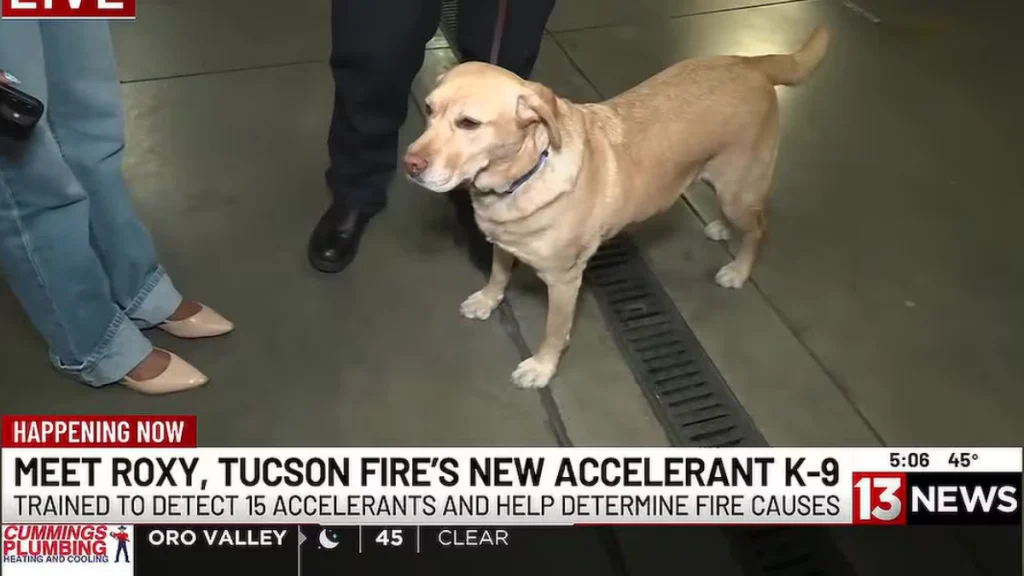
Tucson Fire has a new accelerant detection dog named Roxy to help investigators find evidence at fire scenes, KOLD reported.
Roxy was a stray wandering the streets of Pensacola, Florida, according to KOLD. She ended up at a local shelter there. Someone at the shelter noticed her drive to find things and thought she could work in scent detection.
How Roxy trained for the job
Tucson Fire adopted Roxy in July, KOLD reported. She trained in California, then spent three weeks training in New Jersey.
Roxy can now identify 15 scents linked to fire accelerants, KOLD reported. She can detect small traces within seconds.
Why the accelerant detection dog matters locally
Roxy works with Tucson Fire Investigator Jorge Loya. Before she arrived, the closest accelerant detection dog was based in the Gilbert and Mesa area, KOLD reported.
Loya said the distance used to slow down investigations.
“Those things evaporate with time so the more time that lapses, the less chances of finding it,” Loya said. “If we needed or requested [a dog], from Gilbert and Mesa and it would take a couple hours for them to get that together and come down here, so it makes a huge difference for us.”
Tucson Police have reported 121 arsons so far this year, KOLD said. That compares with 117 arsons in all of 2025.
Roxy is now based in Tucson, according to KOLD. Investigators no longer have to wait hours for a dog to arrive from another city.
Other Arizona departments add similar dogs
Gilbert Fire & Rescue welcomed an accelerant detection dog in December 2025. The city of Gilbert announced the news, Parade reported.
The dog is a yellow Labrador retriever named Xanadu, born April 12, 2023, the city said. She is trained to find trace amounts of several types of ignitable liquids, according to the city.
In Phoenix, the fire department introduced a black Labrador named Gauge in September, azfamily reported. Gauge had recently returned from training and certification in Maine.
Phoenix Fire Capt. Scott Douglas told azfamily that Gauge searches a scene after a fire for ignitable liquids. His nose helps investigators decide where to collect samples, which are later sent to a lab for testing.
Cleveland19 reported that the Bureau of Alcohol, Tobacco, Firearms and Explosives trains dozens of dogs each year. These dogs become accelerant detection canines for fire agencies across the country. It was not reported whether Roxy’s training was tied to that federal program.